Accelerating Digital Transformation in the Construction Field!How BraveJIG Can Help Solve Challenges in the Civil Engineering Sector.
BathTimeFish Inc.
BathTimeFish Inc.
- Business Description
- IT System Development and Consulting Services
- Challenges
-
- The worsening labor shortage at construction sites, especially in the civil engineering sector
- Lack of reliable IoT devices suitable for outdoor environments.
- “Just Right” Points
-
- Dust and water resistance equivalent to IP65
- Reducing installation costs with wireless communication.
- Made in Japan for trusted reliability.
- Implemented Product
-
- BraveJIG
Could you tell us about your business?
At BathTimeFish Inc., we provide custom system development and consulting services focused on digital transformation.
Our approach begins with thorough consulting to understand each client's unique challenges. From there, we can handle the entire process—including in-house application development—based on project needs.
With a background as a software engineer, I have been deeply involved in IoT technologies since their rise nearly a decade ago. I offer end-to-end support, from selecting and implementing the right sensors to building cloud systems—helping clients turn ideas into working business solutions.
Tell us about Kraken and how it incorporates BraveJIG.
Kraken is an open-source software released under the MIT License and available on GitHub. It functions as a cloud backend that processes data after it is uplinked from BraveJIG sensors.
The system consists of two components: Kraken Broker and Kraken Collector. Together, they collect data via MQTT or HTTP, and provide a foundation for developing cloud-side logic such as data storage, processing, database integration, and notifications.
We developed Kraken based on the realization that platforms like AWS IoT and Azure IoT Hub don't always align with every customer’s needs—especially in cases where cost concerns, trust in public cloud, or a desire for fully in-house infrastructure are major considerations.
Put simply, Kraken allows you to build a lightweight, on-premises IoT platform using low-resource hardware—essentially bringing AWS-like capabilities into a device such as a Raspberry Pi.
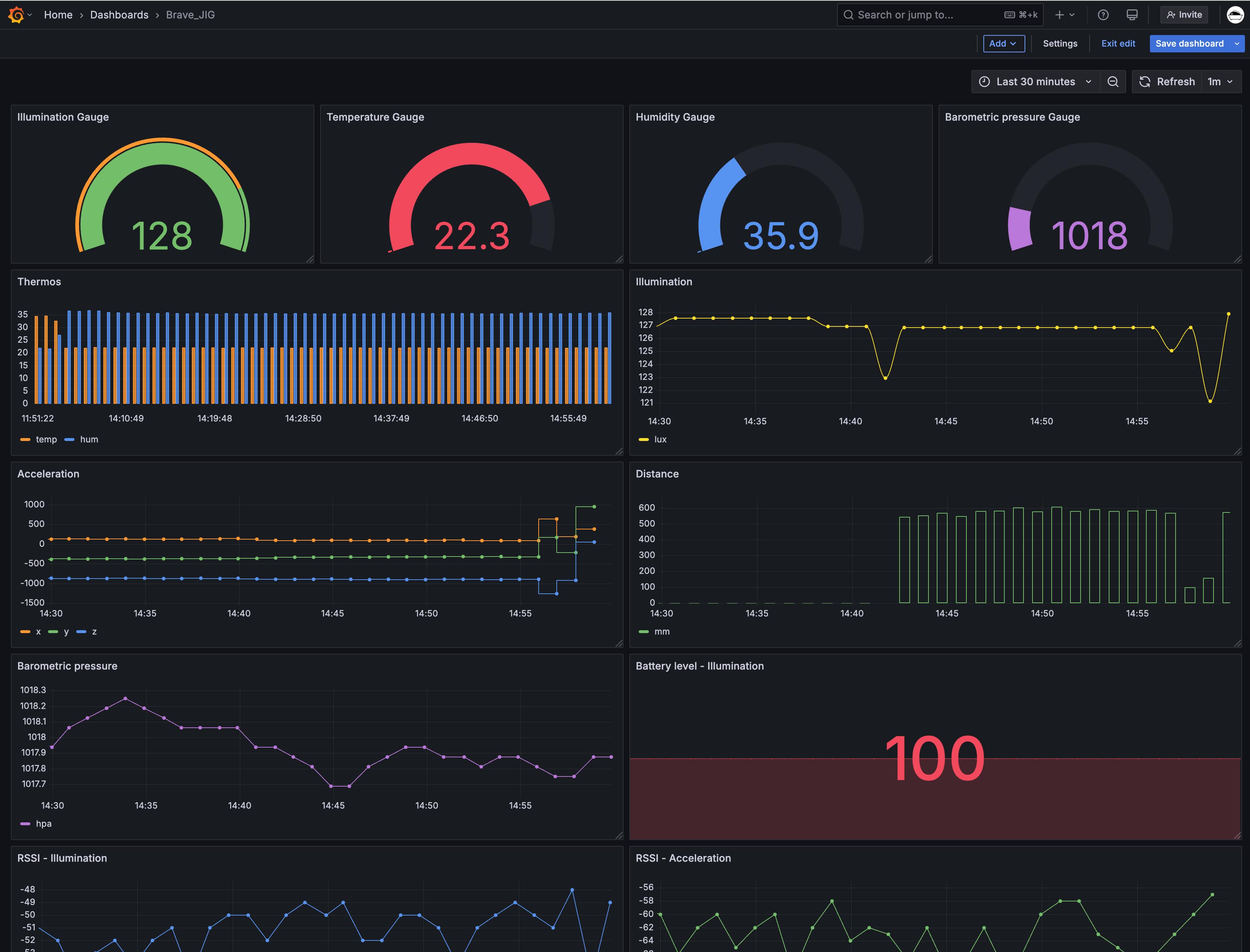
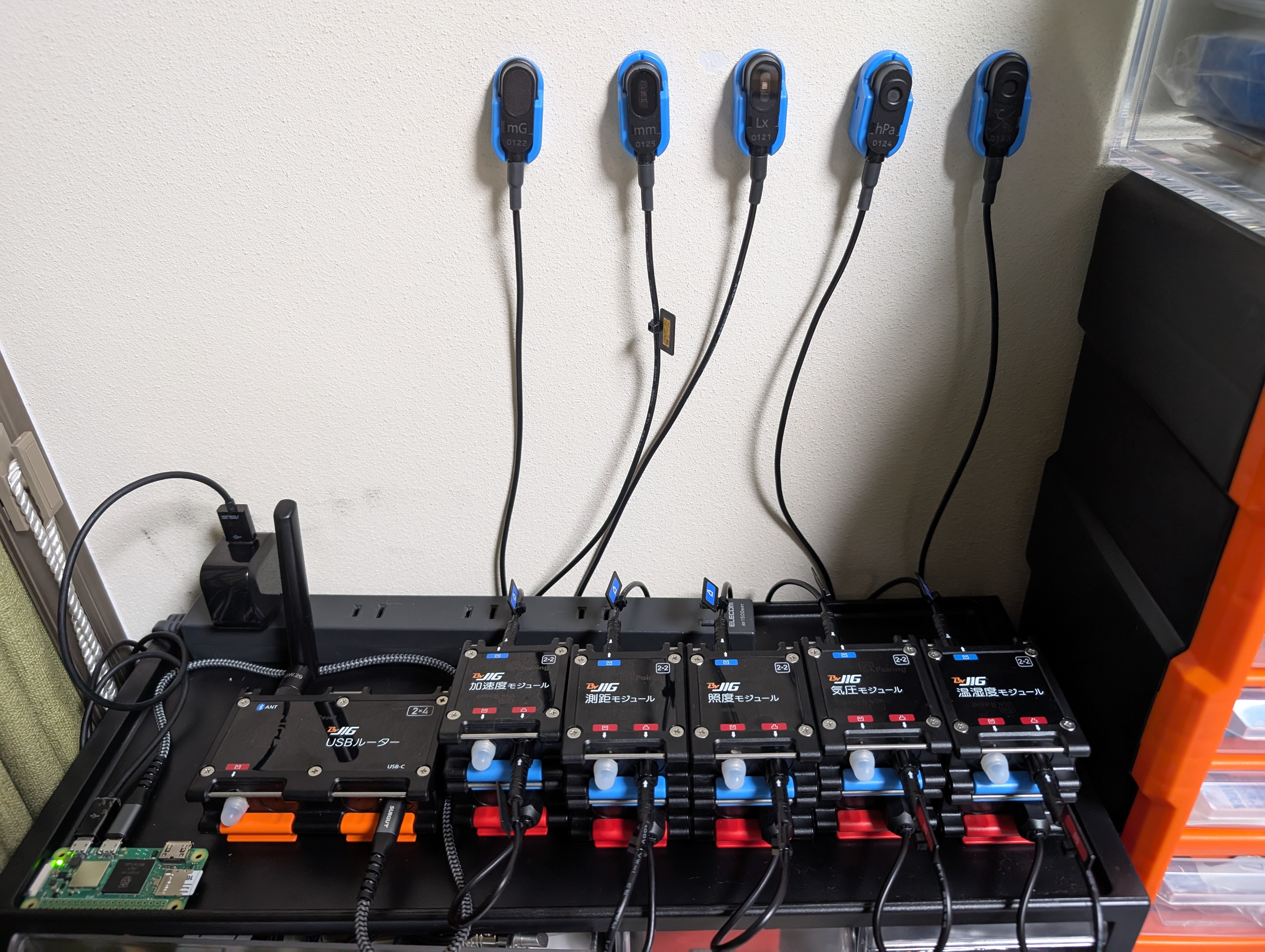
Kraken supports data visualization for all BraveJIG sensor modules currently available.
What industries do you primarily target?
Also, could you tell us the key reasons for using BraveJIG?
Currently, our strongest demand is not from the manufacturing sector or factories, but from construction sites—particularly in the field of civil engineering. In Japan, the construction industry is experiencing a surge in digital transformation (DX), while DX in manufacturing has somewhat stabilized. Construction, on the other hand, is heating up rapidly.
One of the main drivers is the labor shortage, which is even more severe than in manufacturing. While automation through robotics can help alleviate workforce shortages in factories, such solutions are much harder to implement in civil engineering, where many tasks still require manual labor. As a result, fewer workers directly lead to lower productivity.
Only recently have we seen efforts to streamline tasks like inspections using sensors for labor-saving. However, the harsh environmental conditions at civil engineering sites pose another challenge—IP55-level protection is not sufficient. In most cases, IP65 or higher dust- and water-resistance is required.
IoT sensors that meet such rugged requirements are extremely limited. While sensors for infrastructure monitoring—such as those used on bridges for acceleration or strain measurements—do exist, they are generally wired, requiring both power and network infrastructure to be installed. The cost of such installation across multi-kilometer structures can be enormous.
In the past, installation costs often outweighed labor costs, making such solutions unfeasible except for large-scale projects. But today, the labor shortage is so severe that cost is no longer the primary concern—availability of manpower is.
In this context, systems that use Bluetooth LE for data transmission and connect to the local network or cloud via a router offer a very effective solution. Both the transmitter and receiver feature IP65-equivalent dust and water resistance, and their durability allows for reliable outdoor operation. As Japan-made IoT devices, they are well-suited to meet the needs of the construction industry.
Do you have a specific use case in mind for using BraveJIG in the construction industry, such as which sensors you plan to use?
Right now, what I’m most looking forward to is the contact input/output module. On construction sites, contact signals are commonly used—for example, relays often come directly out of the distribution board. Many sites install safety devices that trigger alarms when people or vehicles behave unsafely, and those devices often have contact output functionality.
In road or railway construction, even a moment of inattention can lead to life-threatening accidents. These safety devices are critically important in such environments. However, in many cases, alerts are issued only via buzzers or lamps—meaning that if workers are outside the range of the sound or light, they may not notice the warning at all.
By connecting BraveJIG to these contact points, it's possible to send alerts to smartphones or other devices via the cloud. This allows safety alerts to reach across the entire worksite, helping to improve overall safety management.
If existing devices like these can be easily IoT-enabled using BraveJIG and Kraken, even labor-constrained worksites could maintain safety cost-effectively. I hope this can contribute to building safer and more efficient job sites.
What are your expectations for BraveJIG going forward?
Honestly, I can’t find any real weaknesses in BraveJIG.
When I first heard about it during the planning phase, I thought, “Are you seriously going to make something like that?” (laughs).
But after actually purchasing and implementing it, I genuinely can’t think of any shortcomings.
Even when I hear about new sensors being developed, it always feels like BraveJIG is keeping up with the times. That might be why I don’t have any specific requests at the moment. If anything, I feel like I’m still catching up to everything BraveJIG is already capable of.
If I had to say one thing, I’d love to see even more sensors added to the lineup. The more sensors available, the more ways we can apply them on-site. As digital transformation in construction really starts to take off, I believe the value of BraveJIG—as a flexible and highly expandable platform—will continue to grow.