Start Simple. Scale Fast.
An IoT Solution Driving Efficiency in Manufacturing
ideetouch Co., Ltd.
ideetouch Co., Ltd.
- Business Description
- IT System Development and Consulting
- Challenges
-
- Developing user-friendly systems that promote IoT adoption on the manufacturing floor, accessible to anyone regardless of age or skill level
- “Just Right” Points
-
- Extensive Module Lineup
- Seamless Integration with FileMaker and Easy API Integration
- Implemented Product
-
- BraveJIG
Could you tell us about your business?
Ideetouch Co., Ltd. develops database software using Claris FileMaker, with a focus on iPad-based systems for manufacturing.
Our primary use is factory inspection operations. By replacing paper-based, handwritten processes with iPads on the shop floor, we help improve operational efficiency.
While the need for IoT adoption is widely recognized, many companies are unsure how to proceed. This is especially true for regional factories, where intuitive systems that anyone can use are difficult to find. Even when introduced, systems are often only used effectively by younger employees.
At Ideetouch, we focus on creating systems that anyone can use, regardless of age or IT skill level.
Could you explain the demo application that incorporates BraveJIG?
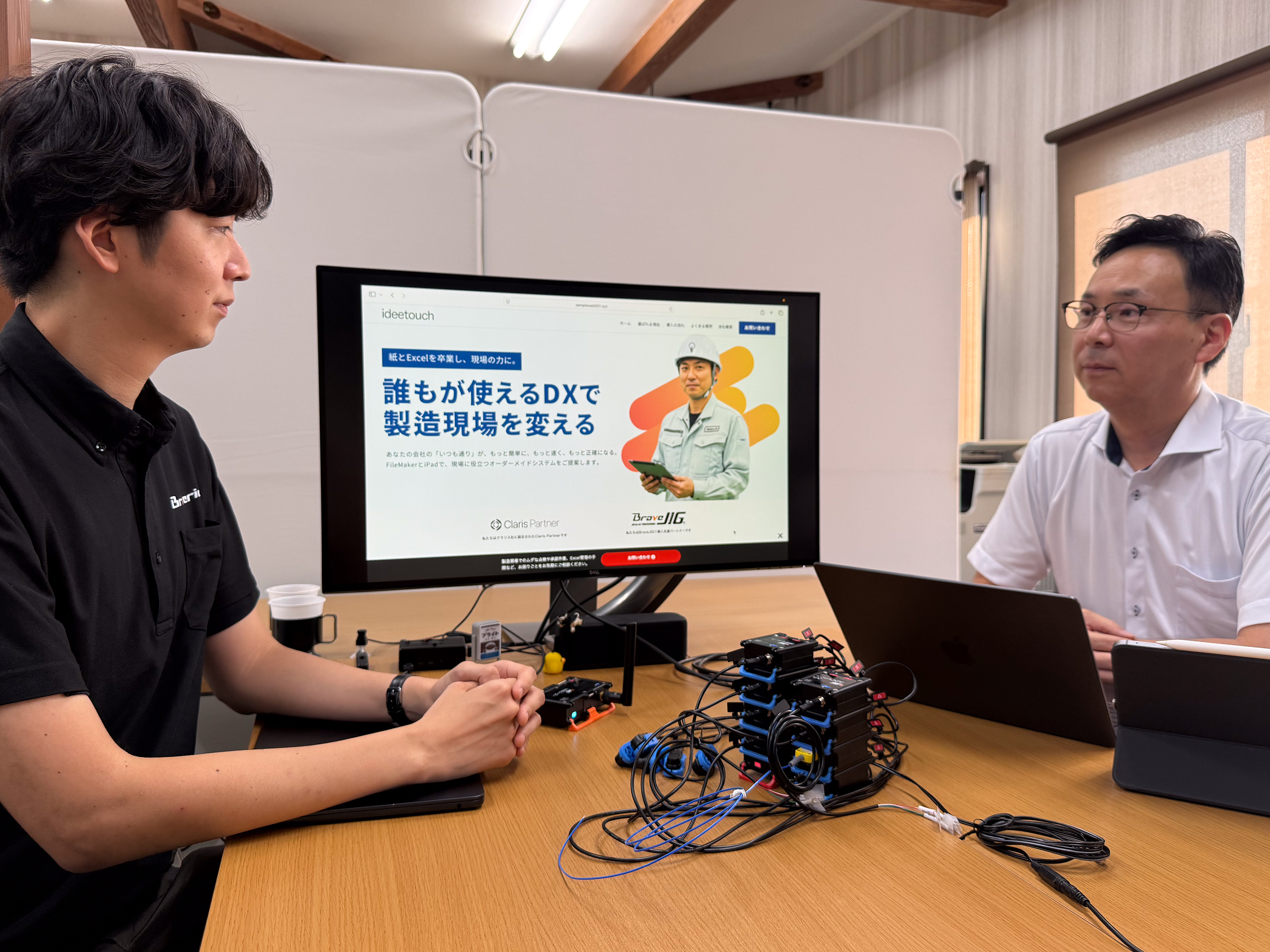
The demo application was developed to help customers clearly understand how data is collected. Simply explaining that “data can be captured” is often not enough, so we created a demo that shows the full process—from data acquisition on a Raspberry Pi to integration into a FileMaker database application.
The application was built using FileMaker Pro and integrated with an IoT starter kit via API. One of FileMaker’s key strengths is that end users can develop and modify systems themselves, enabling flexible operation while keeping costs low.
It also works seamlessly with BraveJIG. Requests such as adding inspection items or connecting new sensors can be handled quickly. By combining BraveJIG with FileMaker, both sensor expansion and system modifications can be carried out rapidly, allowing immediate use on the shop floor.

Demo App Home Screen
How is it actually used in practice?
It can be thought of as a digital version of a daily inspection checklist.
In manufacturing environments, tasks such as measuring and recording humidity, temperature, and vibration are carried out regularly, with frequencies ranging from three times a day to once every hour, depending on the site. By automatically collecting and recording this data using BraveJIG sensors, manual inspection work can be reduced.
Beyond data collection, how the data is utilized is also important. Our system integrates the data with ChatGPT, enabling analysis and predictive maintenance. This allows potential equipment issues to be identified in advance and supports planned maintenance.
Inspection Checklist
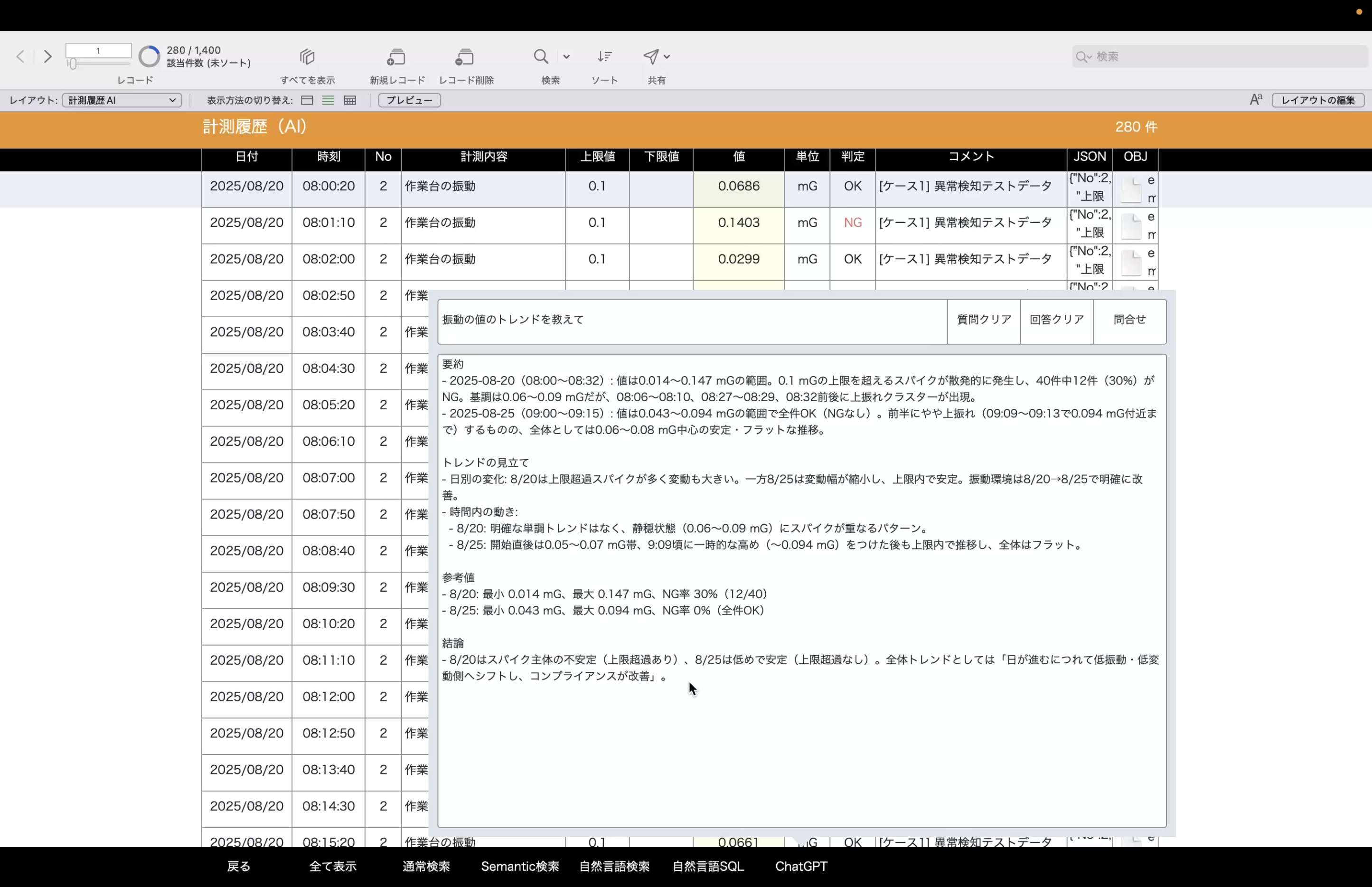
Integration with ChatGPT
What are your expectations for BraveJIG going forward?
We hope to see further expansion of the BraveJIG module lineup.
Each manufacturing site has unique needs, so a practical approach is to start by introducing BraveJIG in areas where inspections can be automated. Once benefits are demonstrated in one or two areas, adoption can naturally expand.
By scaling implementation step by step, we aim to achieve significant labor savings and improved productivity, ultimately allowing people to focus on tasks that require human involvement.
We also look forward to the addition of more diverse sensor modules and functionalities.